Showing posts with label Teacher Tips. Show all posts

Sunday, January 16, 2022

Organizing and Storing Small Group Materials

 Note: This post contains affiliate links. If you make a purchase after clicking on my  links, I receive a small commission at no cost to you! Thanks for your support!


Organizing and Storing Small Group Materials | Apples to Applique

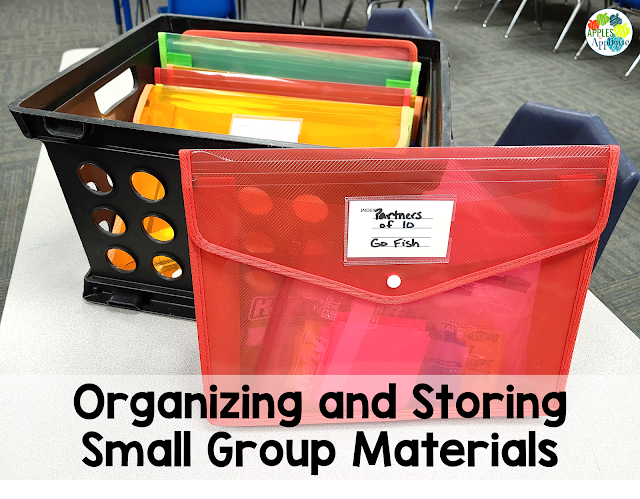
I love hands-on activities for my students, especially for small groups and independent practice. It takes a lot of time to print, cut, and laminate activities, but it's worth it if I can keep them to reuse in future years. However, as I made and accumulated more activities, I quickly realized I needed a system to keep all of those materials organized. I love an organized classroom; clutter stresses me out and I hate wasting planning time digging through things.

I didn't want to use hanging files for my small group activities because most of them had smaller pieces that I also wanted to keep with it. For example, I had a weighing station that called for things like glue sticks, dominoes, and other classroom items for students to put in a scale. I wanted to be able to keep all of those things together so I could grab it and it would be ready to go.

Boxes take up too much space, especially if they are large enough to hold student worksheets, and they can get expensive.

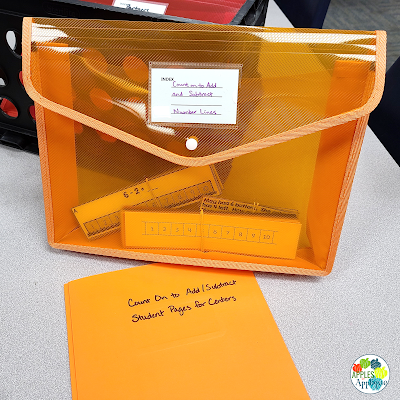
These pocket file folders are perfect! They are large enough to hold manipulatives, cards, etc. while also storing any accompanying worksheets.

Organizing and Storing Small Group Materials | Apples to Applique

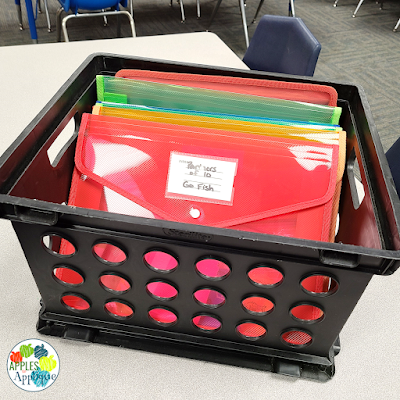
I put student worksheets in a folder, which goes inside the pocket file, so everything is together. I store the file folders in crates on shelves, but you could put them in a file cabinet. 

Organizing and Storing Small Group Materials | Apples to Applique
 

Whenever I'm needing students to practice a specific skill, I just look through the files and see what I already have prepped. It saves so much time and I love having tried-and-true activities at the ready.

Until next time, keep teaching with heart and passion!

Sunday, January 9, 2022

Teaching Young Students About Martin Luther King Jr.

Note: This post contains affiliate links. If you make a purchase after clicking on my  links, I receive a small commission at no cost to you! Thanks for your support!

Nobel Foundation, Public domain, via Wikimedia Commons

As I was prepping lessons for next week, I was planning to spend a few days talking about Martin Luther King, Jr. I turned to the corresponding page in my social studies curriculum and was sorely disappointed to see four short sentences, two of which were discussing how people commemorate MLK Day by having parades and closing schools. That left two sentences discussing the life and work of Dr. King. Even more disappointing, they glossed over the Civil Rights movement, simply stating that Dr. King worked for equal rights for all. There was not even a mention of for whom he was advocating; no discussion of segregation or the Black community.

I understand the thought of not going too in-depth with these heavy subjects with early elementary students, but I was deeply saddened by this casual approach. I fully believe young learners can, and should, engage with deep content. Here's how I approach this in my classroom.

Allow Time

Deeper subjects like this cannot be rushed. This isn't a lesson to throw in that random 10-minute slot you have before recess. Early in my teaching career, I did not allow enough time, and my students were in a place of somber processing as I was trying to get them out the door for lunch; it wasn't good for anyone. Carve out some time so you can approach this in a purposeful manner.

Use Quality Literature

Read alouds are one of the best ways to introduce children to historical figures and events. Take the time to fully read through the books first, selecting books that give sufficient facts and details. I also highly recommend books that have rich illustrations or photographs.

My all-time favorite is Martin's Big Words by Doreen Rappaport. This book is perfect for initiating conversations with students. It keeps things simple enough for K-2 students without ignoring or glossing over the difficult details, and incorporates many quotes from Dr. King.

Another wonderful book is Be a King: Dr. Martin Luther King Jr.'s Dream and You by Carole Boston Weatherford. I use this as a follow-up book, because it really doesn't give details about Dr. King's life, but it helps the students make connections to their own lives, seeing ways they can make a difference.

Cultivate Empathy

Take time to focus on social-emotional skills. Have conversations about how you would feel if you didn't have the same rights as others. Ask students to truly think about how they would feel if they were treated differently from others, such as if they could only go certain restaurants or drink from certain water fountains. Carry these conversations forward into areas of kindness and equality in the classroom, at recess, and in your community.

Answer the Difficult Questions

As you discuss topics like segregation, children will have big, difficult questions, and they deserve to hear honest answers to those questions. Give straightforward, non-biased facts. You'll be surprised at how well your students accept these facts and want to move forward to create a brighter future; I am always impressed with their insight.

Avoid Trivializing Activities 

Those of you who have read my blog for some time know that I am a huge advocate of teaching through play. However, this is a time when that is simply not appropriate. Do not attempt activities like assigning kids a race and role-playing segregation in your classroom (I can't believe I even have to write this, but every year there are news stories of teachers doing things just like this). I personally even avoid things like color-by-code pictures of historical figures like Dr. King, which is my own preference, because I feel like there are more meaningful ways to approach such subjects. I tell my students it is a serious topic and that we are going to have a serious discussion and they usually rise to the occasion; they love feeling trusted to have such conversations.

Through approaches like these, you can help your students engage purposefully with important historical content, laying a solid foundation for them to be critical thinkers as they begin to learn more about the complexities of history and society.

Keep teaching with heart and passion!

Sunday, January 2, 2022

Classroom Management: 5 Steps for Regrouping After Winter Break


Hello, Teacher Friends! I hope you've had a restful break and didn't spend the entire time grading or planning. 

As we come back together after a break and holidays, it is a great time to work on regrouping and refocusing your class for the second half of the school year. I don't know about you, but my class of firsties became a little dysregulated during the last part of December, between the tedium of middle of the year testing and excitement over holidays. Getting everyone back on track in January is going to take some work, but it can be done! I've got five steps that I've learned to follow over the last ten years in the classroom.

1. Expectations, Expectations, Expectations

Of course, every teacher has heard to spend time after a break revisiting expectations. There's a reason this advice is so often repeated--because it's necessary. Don't feel guilty if you get to very little actual curriculum the first week or so after coming back; the time you spend reestablishing procedures will more than be made up.

2. Rethink and Reflect

This is also an ideal time to rethink expectations for yourself, not just your students. Do a little reflection: what is working well in your classroom, and what would you like to change? Are there new procedures you would like to implement? This is the time to do it! Talk to colleagues about what works well for them, read internet articles, and try something new to address specific challenges in your classroom.

3. Involve Students

Every teacher has also heard the strategy of involving students in coming up with social contracts, class rules, etc. If you have already done this with your class this year, revisiting it in January is an excellent idea. The social contract strategy has had varying levels of success for me, depending on the class. However, I had a conversation with a colleague recently about some specifics to implement with this approach that are game changers. First, make sure every student buys in. When discussing expectations, if even one student thinks they cannot meet that expectation successfully, don't add it to the class contract. Explain to them that you want them to feel successful in the expectations they create. Second, after creating your contract, frequently check in with your students--not just when they are misbehaving. Throughout the day, do a whole-class check in, during lessons or after transitions, having kids show you a thumbs up, sideways thumb, or thumbs down, to self-assess how well they are personally doing with following the expectations. (Have them do this in front of their chest rather than with their hands up high, so that other kids can't see their responses). Talk them through what they need to do to reach a thumbs up. I love the level of accountability this gives students while helping them learn to self-reflect.

4. Be Sensitive

Be a safe landing place for them to return to after break; for many kids, school is their safe place and they dread extended breaks. Not all students had an exciting break filled with lavish gifts and experiences, so be mindful of this when facilitating discussions or giving writing assignments about their favorite Christmas gifts. Returning to normalcy as soon as possible will help these students be more successful.

5. Foster Relationships

A large part of successful classroom management comes down to relationships. Take some time this week to foster relationships with your students and between your students. Talk to them, give them time to talk to one another. When students know you genuinely care about them, and your classroom is a true community or family, they are much more likely to do their best and work well together.

Of course, no classroom management plan is a complete fail-safe, but I hope these tips are helpful to your classroom as we embark on 2022!

Keep teaching with heart and passion!


Wednesday, June 2, 2021

School Year in Review: Faves and Flops

Note: This post contains affiliate links. If you make a purchase after clicking on my  links, I receive a small commission at no cost to you! Thanks for your support!

Classroom Faves and Flops | Apples to Applique

This abnormal school year is finally drawing to a close. Though it has been shorter in duration (we started a month later than usual, as did many other districts), it has felt longer with the extra strain of teaching during a pandemic. I was blessed to be fully in-person for most of the year, with the exception of the month between Thanksgiving and Christmas, during which we were remote, but that was not without its challenges. Keeping 6-year-olds distanced and wearing masks, making sure everyone was frequently washing hands, the revolving door of students in quarantine, the lack of in-person connection with parents, the absence of fun traditions like field trips, etc.--it has all taken its toll. As usual, I am sad to tell my students goodbye, but I am more than ready for a break.

Looking back on this crazy year, I thought it would be fun to highlight some of my favorite things, and some things I tried that didn't work out as well. Teaching is an art, and, as with any other art form, you are constantly learning and honing your skill.


Classroom Faves and Flops | Apples to Applique
 

Fave: This adorable rug

My littles love to scooch close to me on the carpet and I am constantly afraid of rocking over their little fingers. I also am a person who gets overwhelmed by too much sensory input, like touching, and sometimes need some space from the little hands that want to constantly be patting or tugging at me. I realized that a rug would provide a perfect visual boundary, as well as being cute. It matches my colorful decor well and, being an inexpensive rag rug, I'm not too worried about it getting torn up. I love the happy pop of color it provides, and it has worked quite well to define my space for my students.

Classroom Faves and Flops | Apples to Applique
They do *not* still look this cute after a year of use!

Flop: Individual student lap desks

Oh, they looked so cute on Pinterest, and as we were being told we had to keep kids spaced apart all day, the collaborative tables I usually use were not an option. Individual desks were low in supply in my district, with everyone wanting them, and it didn't seem age appropriate to ask first graders to sit at them all day. This seemed like such a good option!

At first, I loved it, and my kids loved it. But as time went on, I realized the desks were a pain. They were so lightweight that they got kicked/knocked over easily, they moved about too freely on the carpet, and they became a catch-all for all the little things that 6-year-olds treasure (read: stuff that should be thrown away). They also were not as sturdy as I had hoped, and it didn't take long for many of them to crack. Surprisingly, many of my students started requesting to sit at the couple of traditional desks I had left in the room. As I had already suspected in years prior, the kids do better with occasional movement, and going from desk to floor sitting throughout the day provides that.

I'm looking forward to ditching the individual desks and returning to collaborative tables next year, but hey, I tried something new!


Classroom Faves and Flops | Apples to Applique

Fave: This student mailbox system

This helped so much with organization and made it possible for me to only send home papers once a week, as opposed to every day, without having them piled on my desk or having the kids shove them in their cubbies. It was a little pricey, but it was worth it to me to get the wooden version as opposed to the cardboard versions. It also took a bit of time to put together, but I am so glad I took that time.

Classroom Faves and Flops | Apples to Applique
 

Flop: Yoga mats for students 

These seemed like a great idea to accompany the lap desks. However, it didn't take long for little pieces of the foam to start flaking off. I even had a couple of students cut slits in the sides of them with safety scissors, so they just weren't durable enough for daily classroom use. They also became a tripping hazard, and cleaning and rolling them up each day became quite the chore. This flexible seating option gets a hard "no" from me.


Classroom Faves and Flops | Apples to Applique

Fave: This small group system

I love, love, love this thing! It makes it so easy to change groups around and to organize materials--provided they are worksheet-type activities. My only complaint is that it's not convenient to organize small group activities such as games, which I tend to utilize a lot in my classroom. On those days, I put a note in the file folder that lists/explains the day's activity and then put the activity materials in a color-coordinated tub. Problem solved! This system makes things really easy for subs, paras, and anyone else who may be coming in to work with small groups.


Classroom Faves and Flops | Apples to Applique

Flop: This headphones organizer

You guys, I really wanted to love this. It seemed like such a great organizational solution! I even created an editable headphones organizer that I listed in my TPT store. This may be fine for older grades, but most of my kids were too short to reach the top row or two. The bottom of the organizer was already at the floor, so I couldn't lower it anymore. The weight of all of the headphones (plus the kids yanking on it trying to get headphones out from higher rows) proved to be too much for the Command hooks holding it on the wall, too, so I was having to frequently rehang it. All in all, I decided it was easier for the kids to keep their headphones in the baskets in their cubbies.

Well, there's my list of faves and flops for the 2020-2021 school year. I would love to hear your own faves and flops!

Until next time, keep teaching with heart and passion!

Wednesday, August 5, 2020

DIY Teacher Survival Kit: 2020 Style

Note: This post contains affiliate links. If you make a purchase after clicking on one of these links, I will receive a small compensation at no cost to you.

Teacher Survival Kit | Apples to Applique

Getting ready to go back to school is totally nerve-wracking this year, and wrought with so many emotions. I am excited to be back in the classroom, which is my happy place; I've missed it terribly since March, when we transitioned to remote learning. I can't wait to meet a new set of kids to love and learn with, forming a tight-knit community. I even miss the little things, like putting up new bulletin boards and decorating for the holidays. My teacher-heart is thrilled to be heading back!

Mixed with all of the excitement, however, is a feeling of unease. Will we be able to help the kids understand the importance of social distancing? Will we still be able to foster the same feeling of community when the kids have to stay so far apart? Will our school have a coronavirus outbreak? Will our students and staff all stay healthy?

Understanding these mixed emotions, I decided to make a 2020 style Teacher Survival Kit as a back-to-school gift for my teammates. My teammates are the most amazing people out there; we work together so well and they inspire me to be the best teacher I can be. We are very close, and always give each other little gifts for occasions like this. However, this gift would also be great from a student to a teacher!

Most of the things included are often seen in teacher survival kits, but some I selected specifically for 2020:
Chocolate (always a necessity! These Dove dark chocolates are my favorite, and I love the little affirming messages inside each wrapper)
Gum
Mints
Ibuprofen
Stickers with inspirational messages (I purchased different styles to match my teammates' classroom decor; the ones pictured I found from Happy Honeycomb Studio on Etsy)
Travel hand sanitizer that can be put on a lanyard (Because, 2020...I purchased these holders)
Lotion (to combat the dryness from the frequent hand washing. I purchased this lotion with a calming lavender scent, because goodness knows we need a little calm this year!)
Box of Blessings (this little deck contains 101 blessings for teachers)
Emergen-C (not pictured, but I added it in after taking the photo. Teachers can always use this immune system boost in a good year, but in 2020, we need it in bulk!)

Last but not least, I found these adorable Teacher Survival Kit bags to package it all in.

Teacher Survival Kit | Apples to Applique

Hopefully these goodie bags will bring a smile to my teammates' faces as we face the uncertainties of this upcoming school year.

Is there anything else you can think of that should be put into a teacher survival kit, especially this year? Let me know, I would love to hear your ideas!

Keep teaching with heart and passion!


Friday, March 27, 2020

Setting Up an Easy Virtual Classroom | Distance Learning Series #3

This post is third in a series on distance learning. You can find the other installments here: 
Connecting with Students During Distance Learning
5 Teacher Tips to Save Your Sanity During Distance Learning

Setting Up an Easy Virtual Classroom | Apples to Applique
This has been a crazy whirlwind of a ride, learning how to shift mid-year from a traditional school setting to distance learning. There has been so much for me to learn as a teacher, and I know it has only just begun!

There are many platforms available out there to use for distance learning. Since I teach first grade, my goal was to make my virtual classroom easy for both my parents and students to navigate. Some options that work well for older students just weren't a great option for 6- and 7-year-olds.

The best option that I came across to meet my needs was a Google Site. It is free and user-friendly. I love that I can quickly and easily insert resources right from my Google Drive, embed videos from other websites, and add features like Google Forms so that students can check in with me. (No, this post is not sponsored by Google 😉 ). I've heard great things about Google Classroom, too, but, unfortunately, I was not able to try it out, as my district does not give students email access in 1st grade.

The thing I like about having a class website is that everything is in one location. This was important to me so that I would not overwhelm my parents. I'm sure they are overwhelmed enough right now! From that one location, I either embed or link everything the students need for the week, including any videos or printables, and even assignments from specials teachers! I directly link to the platform I am using for students to submit assignments, so parents don't have to remember anything more than just the one site.

I added tabs and pages, and was able to quickly and easily hyperlink to other pages on my site to help parents find what they are looking for. Nowadays, most parents are comfortable with navigating websites, so having a one-stop place for them to go helps ease their mind as they learn how to "homeschool". Even better, it can be accessed on their phones, tablets, etc. so they can check things on the go.

You can make your site as simple or complicated as you want. If I were using Google Sites for other purposes, I would probably bemoan the lack of customization features, but for these purposes, it's perfect! Everything is pretty much drag and drop, which is just what I needed. No messing with html, no finicky settings to worry about messing up. In just a few hours, I made a professional-looking website that I could push out to kids and parents, where they can access everything they need to do their schoolwork at home. It's super easy to edit, too, when I need to change plans for the next week.

Now that I've got it set up and ready to go, I feel like I can breathe a sigh of relief and focus on what's really important: helping my kids to keep learning these next couple of months!

Stay tuned for more distance learning tips, and hang in there!
Keep teaching with heart and passion!


Wednesday, March 25, 2020

5 Teacher Tips to Save Your Sanity During Distance Learning | Distance Learning Series #2

This post is second in a series on distance learning. If you missed the first installment, all about connecting with students, check it out here!

http://www.applestoapplique.com/2020/03/connecting-with-students-during.html
Shifting mid-year from traditional schooling to distance learning is certainly not something we ever thought we would have to prepare for as educators. There are so many questions and unknowns as we enter these uncharted waters!

I served on the Continuous Learning Task Force for my district as we figured out how to move forward for the remainder of this school year. Here are the five main things I took away.

1. Less is More
I have been repeating this often to myself over the last week or so; it's becoming my new mantra. "Less is more." Focus on the "meat" of your lessons and standards, and don't worry about the fluff. What is it absolutely essential for kids to know by the end of the year? What will they need to master before entering the next grade level? Focus on those things.

2. Keep it Simple
Don't try to learn every new platform and program. I know that I have been inundated with emails and advertisements from every education platform and website, all touting why they're the best for at-home learning, or how they are offering free subscriptions right now. Some of them sound amazing! It is tempting to try to learn and do them all. I appreciate these companies stepping up and helping teachers and parents, but it is all overwhelming. I am going to continue using platforms and programs that I have already been using, and with which my students and their parents are already familiar. We are already having too much new stuff thrown at us; we don't need to add in one more thing to figure out and adjust to.

3. Be Flexible
Some people are having a hard time wrapping their minds around this new approach to teaching, and are thinking they need to have a strict classroom schedule with live lessons at set times. That's just not realistic. Many teachers have young children at home who are going to run screaming through the room during a live lesson, or who will need to be online completing their own assignments. Many students will still be at daycare during the day and will need to complete assignments in the evening, or complete several days worth of assignments in one day. One of the beautiful things about distance learning is that it can be worked around family schedules. Give yourself--and your students--a lot of grace. Everyone is doing the best they can.

4. Be Available
While being flexible, it is important that you are available to your students and parents. Distance learning is not "set it and forget it". You cannot upload assignments for the week and then enjoy a week of "paid vacation". Students and parents will have questions and need assistance. Students will miss you and want to connect with you. You might choose to schedule some live videos or lessons so that you can connect with students, but make sure to record them and upload them to your chosen platform so that all students can access them later.
Many districts are recommending set office hours. This can be difficult to achieve for those of us who have littles at home, but make sure you are checking your email, messages, etc. multiple times a day and responding promptly. You are still their teacher, and you still have an obligation to give them a quality education.

5. Set Boundaries
Being available does not mean that you are obligated to respond to parent emails and phone calls at 10:00 pm or on weekends. If you choose to do that because it works for you and your schedule, great! Just remember that you are not constantly on-call, and it is okay to set aside personal time when you are not available. If you need to schedule a set lunch and planning time during the day in order to ensure you don't get burnt out, do it. Whatever works for you, just don't forget to take care of yourself. You can't pour from an empty cup.

Stay tuned for more tips on distance learning, and remember to breathe. We will get through this together! Even in the midst of the unknown, keep teaching with heart and passion!


Friday, March 20, 2020

Connecting with Students During Distance Learning | Distance Learning Series #1

8 Creative Ways to Connect with Students During Distance Learning | Apples to Applique

This is such a crazy time for the world of education! Having heard of some school closings around the country, I was prepared to possibly not see my kids for a few weeks as I sent them home for spring break. When, just a few days into spring break, I received word that our governor had shut down schools in our state for the rest of the year, I was devastated. I wasn't ready to say goodbye forever! Those kids are my babies, and the two months I thought I had left had already felt too short. This abrupt end was too much.

I grieved for a bit, and now, I am ready to move forward. They are still my students, and I will still teach them. Of course, we are working on changing our approach so that our students can still receive an education while we are all under quarantine. It will look different, it will feel different, and we may not like the change, but we will all get through it together.

I am going to be publishing a series of posts on distance learning, including activities for parents to do at home, as well as tips for teachers. This seemed like the best topic to start with, as first and foremost, kids should feel loved! Kids always, always need to feel loved, but even more so in times like these. Things are scary and uncertain right now; even little ones can pick up on these feelings from the adults in their lives. We need to do our part to be a stabilizing force, and to make sure the kids know there are grown ups in their lives who love them and are thinking of them.

Fostering relationships with students is vital to a solid education in the best of times, but it is going to take a lot more effort in this kind of setting. Here are some fun ideas to help you connect to your students in spite of the distance.

1. Send them a card
Kids LOVE getting mail! Sending each of your kids a sweet little note to say you're thinking of them will make their day.

8 Creative Ways to Connect with Students During Distance Learning | Apples to Applique

Of course, cards and postage can get expensive, and if you don't have any on hand you may not want (or be able) to go to the store right now. E-cards are a fantastic option! Several sites offer a few free e-cards; I found some adorable ones at Kisseo (this post isn't sponsored by them or anything; I just did a search and liked what I found there).

2. Make them a personalized word search or crossword puzzle
I just made one of these for my class using their names and uploaded it to my ClassDojo page, and they were so excited! I'm going to make one for each of them individually with their own interests and message it to them.

8 Creative Ways to Connect with Students During Distance Learning | Apples to Applique


There are many sites out there that will generate word search puzzles. My favorite one so far is The Word Search, because it is easy to use and lets you set the difficulty (such as if you want words to go backward or diagonal). You can download and save it to be printed, or it gives you a hyperlink where the kids can go to play it online. The great part about playing it online is that after the kids solve the puzzle, they can click "play again" and it will rearrange the words. The puzzles are public, though, before they are deleted after 30-60 days, so don't use any identifying information like kids' last names.

3. Audio record a personalized message and send them a QR code to hear it
You could record a message to your whole class, to individual students, or both! Do you know how much fun the kids would have scanning the QR code and hearing you talk to them?
The easiest way I have found to do this is to record the audio using an app on my phone or computer, and then upload the file to Google Drive. (You automatically have access to Google Drive if you have a Gmail account, which is free to set up!) Then you click on your audio file in Google Drive, and click "get sharable link". Highlight and copy the link that shows up, and paste it into a QR generator, such as QR Stuff. It will generate the QR code, and you can save it as an image and send it in an email or upload it to your digital classroom. You could also just send the link without the QR code, if the kids don't have access to tablets.

4. Record yourself reading a story to your kids
Get your webcam up and running, and read some of your favorite stories to your kids. Upload the video to YouTube. You can set it as "unlisted" so that only people with the link can watch it, and then send the link to your students. Many platforms also allow you to upload a video there, as well.

8 Creative Ways to Connect with Students During Distance Learning | Apples to Applique

Ask the students for suggestions on other books to read--they would love to hear you read some of their favorites!

5. Record yourself singing, rapping, dancing, using puppets, telling jokes, being silly...anything that feels like you!
You are the magic in your classroom, and that magic could easily get lost in a digital setting. Do whatever makes you feel in your element, and record it! This could be lesson related, or it could just be you connecting with your kids; both have value. Upload the video just as you did for your read aloud in #4.

6. Create a digital scavenger hunt
These are so much fun, and can be as easy or complicated as you want. You could create one in Google Forms, use an app like GooseChase, or just type up a list and post it in your classroom platform.

8 Creative Ways to Connect with Students During Distance Learning | Apples to Applique
GooseChase has lots of pre-made scavenger hunts you can customize!

Yes, this could be used as a fun way to complete assignments, but you could also just use it as a way to build connections with students, with no set academic purpose. See who can come up with the most creative answers to simple questions like "Find something prickly", or "Take a picture of something falling". The sky is the limit!

7. Have a virtual talent show
If your kids all have access to tablets or laptops, have them all record a short video of something they are good at and share it with the class. Kids always love showing off their mad skills!

8. Have virtual contests
Tablets and laptops are also required for this one, but you could have contests like "Best Music Video", "Best Commercial for Macaroni and Cheese", "Best Dance Moves". The kids could upload their entries to your class platform and enjoy connecting with one another.

I would love to hear any other ideas you have for continuing to build solid relationships with students while teaching virtually.
Stay tuned for more posts about distance learning; we'll make the most of this together!

Keep teaching with heart and passion!