You know when you try something new with your students, unsure of how it will go, and then they blow you away with how well they do? That's exactly how scavenger hunts have gone in my Pre-K classroom. They are my new favorite activity to do with students! It gets them up and moving, and working together.
The first time we attempted a scavenger hunt, I was sure it was going to be a disaster. I put the kids in pairs, showed them how to check things off their list, and turned them loose with a clipboard and a pen. Then I waited for mass chaos to ensue...and it didn't. Maybe it was because they felt grown up using pens and clip boards, maybe it was because they were able to use some critical thinking skills, or maybe it was because they felt I trusted them and rose to the occasion--whatever the reason, my students worked hard! They synergized and found all of the items on their lists, very methodically checking off items. It was the cutest thing ever, and definitely one of those "this is why I teach" moments.
Since that initial success, I have made scavenger hunts to target many different skills. I have a scavenger hunt for colors, 2D shapes, 3D shapes, textures, beginning sounds, rhyming words, and functional pairs. They provide a great way for students to demonstrate understanding of a topic, and, just as importantly, the kids love them! Yes, the kids need a little guidance as most of them are not yet able to read the words, but there are picture clues on the sheets to help out. The visuals on the page really assist them in completing the activity more independently. Additionally, the words used in the beginning sounds and rhyming hunts are all sight words or simple CVC words, so some students are able to complete them all on their own, depending on their level. My students who need a little more help check in with me when they are ready to search for their next item, then go off on their own to find it. That gives me the chance to make sure they are on track as they go, but gives them the freedom to show what they know. And they know a lot more than we sometimes give them credit for!
Get your scavenger hunts here, and enjoy watching your little learners show off their skills!
Thursday, February 8, 2018
Friday, January 5, 2018
Teaching Leader in Me in Early Childhood
I am super proud to be part of a Leader in Me School! It is an excellent program, one that I believe will help establish a solid foundation for students' entire lives. The Leader in Me is built on the principles of the 7 Habits of Highly Effective People by Franklin Covey.
One of the cool things is that, as the program grows in our school, the upper grades get to build on foundations laid by teachers the years before, and expand more on them. However, in Pre-K, I am a child's first teacher. I am the one laying the foundation for the very first time. Every year I start fresh, and I can't build on the work done by another teacher. This has been a unique challenge to me as I seek to embed these skills in the lives of my students in a deep and meaningful way.
Here are some tricks I've learned over the last several years of teaching the Leader in Me to Pre-K students. Many of these ideas would be just as applicable to kindergarten or first grade students, too.
Note: Due to copyright restrictions, I do not offer any 7 Habits or Leader in Me materials in my Teachers Pay Teachers store. The things pictured here are things I created solely for my own classroom use. If you like something you see, I encourage you to try making a version for your own classroom!
Help students recognize the habits in action by having a 7 Habits clip chart. I ditched my old behavior clip chart and use this one purely to recognize good behavior. When I see kids working together, for example, I say, "Wow, I see these two friends using great synergy! I'm moving their clip to 'Habit 6: Synergize' on the chart!" Their clips get to stay on the chart for the rest of the week. I also give them a wristband to wear so they have a visual to take home and tell their parents about.
Ideally, I want the students to begin pointing out the habits they see exemplified by their friends, and ask to move their friends' clips. This is such a powerful way to connect the habits to their everyday lives.
We use a "Choose Your Weather" check-in in my classroom, as well. (Sorry for the weird photo angle). Every day, students come put their name on whatever kind of day they are having. This brings up some great conversations about being proactive and choosing to have a good attitude, as well as how to begin with the end in mind, and what choices we can make if we want to have a "sunny" day. Of course, because I am also a huge proponent of helping children feel and understand their emotions, I also tell them that sometimes we all have "stormy" days, and that's okay. Something I say to my kids often is "It's okay to feel angry, but you still have to make good choices." Then we talk about appropriate versus inappropriate ways to handle our anger.
Another vital thing is to give every child a chance to be a leader. We have our class leadership roles, which rotate weekly. Every student, no matter their age or ability level, gets a turn in every role. I have been shocked at how my little ones, even my 3-year-olds, rise to the occasion and show that even the tiniest kids can be leaders. I have non-verbal students who lead our daily recitation of the 7 Habits by leading the class in the accompanying actions; I have kids who I didn't think could handle a certain leadership task just blow me away by how seriously they take their responsibility. I have learned that every child is capable of so much more than I think, and that when I give them the chance to step up and shine, they do.
One of my favorite things has been watching my students find opportunities to lead that I didn't think of. I have the 20 assigned leadership roles, but my students find so many other ways in which to lead! When they come up with those new ideas, I let them keep that role permanently.
For example, I had an ESOL student who was very hesitant to talk in class. However, she noticed everything, and started taking it upon herself to get the doorstop and put it under the door for me whenever we needed to leave the classroom. It was a perfect opportunity for her to take ownership of something in a way that made her feel comfortable; she didn't have to speak to see a need and take care of it. That became her daily responsibility for the rest of the school year. I didn't want to take her feeling of leadership and empowerment away from her by rotating that role with other students.
I had another student who took it upon himself to help all of the other students with the soap dispenser when it was time to wash their hands for snack. Typically I took care of this task, and had never even thought of delegating it to a student. This child started doing it one day, and then kept on every day after that. This was a student who had some behavior challenges, so having his very own responsibility really gave him a feeling of importance and control.
I could go on about how much I support the Leader in Me program, and how I believe it is effective, even for the youngest students. I hope these ideas help you as you implement the Leader in Me in your own early childhood classroom. I would love to hear other ideas from you as well, so leave me a comment!
One of the cool things is that, as the program grows in our school, the upper grades get to build on foundations laid by teachers the years before, and expand more on them. However, in Pre-K, I am a child's first teacher. I am the one laying the foundation for the very first time. Every year I start fresh, and I can't build on the work done by another teacher. This has been a unique challenge to me as I seek to embed these skills in the lives of my students in a deep and meaningful way.
Here are some tricks I've learned over the last several years of teaching the Leader in Me to Pre-K students. Many of these ideas would be just as applicable to kindergarten or first grade students, too.
Note: Due to copyright restrictions, I do not offer any 7 Habits or Leader in Me materials in my Teachers Pay Teachers store. The things pictured here are things I created solely for my own classroom use. If you like something you see, I encourage you to try making a version for your own classroom!
Help students recognize the habits in action by having a 7 Habits clip chart. I ditched my old behavior clip chart and use this one purely to recognize good behavior. When I see kids working together, for example, I say, "Wow, I see these two friends using great synergy! I'm moving their clip to 'Habit 6: Synergize' on the chart!" Their clips get to stay on the chart for the rest of the week. I also give them a wristband to wear so they have a visual to take home and tell their parents about.
Ideally, I want the students to begin pointing out the habits they see exemplified by their friends, and ask to move their friends' clips. This is such a powerful way to connect the habits to their everyday lives.
We use a "Choose Your Weather" check-in in my classroom, as well. (Sorry for the weird photo angle). Every day, students come put their name on whatever kind of day they are having. This brings up some great conversations about being proactive and choosing to have a good attitude, as well as how to begin with the end in mind, and what choices we can make if we want to have a "sunny" day. Of course, because I am also a huge proponent of helping children feel and understand their emotions, I also tell them that sometimes we all have "stormy" days, and that's okay. Something I say to my kids often is "It's okay to feel angry, but you still have to make good choices." Then we talk about appropriate versus inappropriate ways to handle our anger.
Another vital thing is to give every child a chance to be a leader. We have our class leadership roles, which rotate weekly. Every student, no matter their age or ability level, gets a turn in every role. I have been shocked at how my little ones, even my 3-year-olds, rise to the occasion and show that even the tiniest kids can be leaders. I have non-verbal students who lead our daily recitation of the 7 Habits by leading the class in the accompanying actions; I have kids who I didn't think could handle a certain leadership task just blow me away by how seriously they take their responsibility. I have learned that every child is capable of so much more than I think, and that when I give them the chance to step up and shine, they do.
![]() |
| While I don't offer this exact leadership chart due to copyright reasons, you can find many similar ones here in my Teachers Pay Teachers store! |
One of my favorite things has been watching my students find opportunities to lead that I didn't think of. I have the 20 assigned leadership roles, but my students find so many other ways in which to lead! When they come up with those new ideas, I let them keep that role permanently.
For example, I had an ESOL student who was very hesitant to talk in class. However, she noticed everything, and started taking it upon herself to get the doorstop and put it under the door for me whenever we needed to leave the classroom. It was a perfect opportunity for her to take ownership of something in a way that made her feel comfortable; she didn't have to speak to see a need and take care of it. That became her daily responsibility for the rest of the school year. I didn't want to take her feeling of leadership and empowerment away from her by rotating that role with other students.
I had another student who took it upon himself to help all of the other students with the soap dispenser when it was time to wash their hands for snack. Typically I took care of this task, and had never even thought of delegating it to a student. This child started doing it one day, and then kept on every day after that. This was a student who had some behavior challenges, so having his very own responsibility really gave him a feeling of importance and control.
I could go on about how much I support the Leader in Me program, and how I believe it is effective, even for the youngest students. I hope these ideas help you as you implement the Leader in Me in your own early childhood classroom. I would love to hear other ideas from you as well, so leave me a comment!
Thursday, December 28, 2017
Compound Word Valentine Activity
This post is a throwback to one of the first blog posts I wrote almost 6 years ago (yikes!). In it I described how to make a fun compound word activity with broken hearts.
Making activities is always fun, but let's be honest, most of us teachers just don't have time to make all the cute Pinterest activities out there. That's why I finally created this game and listed it in my Teachers Pay Teachers store!
As both a SPED and Reg-Ed teacher, I have such a variety of ability levels in my classroom, so I always love to include easy options for differentiation in my activities. This game is no exception. There are a few options for this game. It is versatile enough that it can be an independent word work or literacy station for learners who are ready for it, a small group or guided activity for those who need a little scaffolding, or even a large group activity to get everyone in on the action.
For lower level learners, give them both the broken pieces and the whole "answer" hearts. They can work on their print awareness by matching the printed words.
For higher level learners, omit the whole "answer" hearts and give them only the broken hearts, so they have to use more higher order thinking skills, instead of just matching.
For whole group play, distribute all of the broken heart pieces and have students find their partner. This could be done without the whole hearts, or by having the whole hearts on display at the front of the room; partners have to go stand by their whole heart when they have found each other.
Grab this game here, and leave me a comment to let me know how you use it in your classroom!
Making activities is always fun, but let's be honest, most of us teachers just don't have time to make all the cute Pinterest activities out there. That's why I finally created this game and listed it in my Teachers Pay Teachers store!
| Compound Word Matching Activity |
As both a SPED and Reg-Ed teacher, I have such a variety of ability levels in my classroom, so I always love to include easy options for differentiation in my activities. This game is no exception. There are a few options for this game. It is versatile enough that it can be an independent word work or literacy station for learners who are ready for it, a small group or guided activity for those who need a little scaffolding, or even a large group activity to get everyone in on the action.
For higher level learners, omit the whole "answer" hearts and give them only the broken hearts, so they have to use more higher order thinking skills, instead of just matching.
For whole group play, distribute all of the broken heart pieces and have students find their partner. This could be done without the whole hearts, or by having the whole hearts on display at the front of the room; partners have to go stand by their whole heart when they have found each other.
Grab this game here, and leave me a comment to let me know how you use it in your classroom!
Labels:
Kids,
Literacy,
Reading/Writing,
School,
Teachers Pay Teachers,
Valentine's Day
Thursday, November 9, 2017
Fun Thanksgiving Activities!
Can you believe Thanksgiving is just two weeks away?! Where is this school year going?
I just wanted to quickly share with you a couple of fun Thanksgiving resources. They are both no-prep, which makes them perfect for using as a culminating activity after a class Thanksgiving party.
The first one is a Thanksgiving Colors Emergent Reader, from my new line of seasonal color books. Students will color in a seasonal item for each of 11 basic colors: red, orange, yellow, green, blue, purple, pink, brown, black, gray, and white. They will also trace the color word, giving them practice spelling. Click here to get this resource!
The second resource is a Thanksgiving word match book with the same sight words and sentence pattern on each page, to assist in learning to read. Students build fine motor skills as they cut out pictures to match to the words. Get this resource here!
I hope you and your students enjoy these activities! Have a blessed Thanksgiving!
I just wanted to quickly share with you a couple of fun Thanksgiving resources. They are both no-prep, which makes them perfect for using as a culminating activity after a class Thanksgiving party.
The first one is a Thanksgiving Colors Emergent Reader, from my new line of seasonal color books. Students will color in a seasonal item for each of 11 basic colors: red, orange, yellow, green, blue, purple, pink, brown, black, gray, and white. They will also trace the color word, giving them practice spelling. Click here to get this resource!
The second resource is a Thanksgiving word match book with the same sight words and sentence pattern on each page, to assist in learning to read. Students build fine motor skills as they cut out pictures to match to the words. Get this resource here!
I hope you and your students enjoy these activities! Have a blessed Thanksgiving!
Labels:
Holidays,
Literacy,
Reading/Writing,
School,
Teachers Pay Teachers,
Thanksgiving
Sunday, October 22, 2017
Encouraging Mindfulness in Early Childhood
Last year, I had some rough behaviors in my room. I mean, rough. As the year went on, I became frustrated and exhausted, but I also discovered one important commonality: these kiddos who kept acting out had all experienced trauma.
I don't just mean what my therapist husband calls "Little t trauma", I'm talking about "Big T Trauma". Stuff little kids should never have to worry about.
Kids don't know how to appropriately process and respond to that kind of stuff (and if we're honest, many of us as adults don't know how, either!), so they react. They lash out, they act up, they do anything they can to try to gain some kind of control over their little worlds, and to make sense of their lives.
Unfortunately, there is not a thing we as teachers can do to change situations in these kids' lives outside of school. We are completely powerless in that area. BUT, what we can do, is give them tools to process what they are going through. After the year I had last year, I spent all summer researching. How to calm irate children, how to stop outbursts and misbehavior. What I found is not at all surprising: there is no easy fix. The important thing is to give kids strategies, to teach them how to respond instead of react.
One word that kept coming up in my reading was mindfulness. Eagerly, I searched and searched for articles explaining how to teach mindfulness in early childhood, but I kept coming up empty. The problem is, mindfulness is something that must be learned, but it isn't something you can really teach. It's something that must be done intentionally and with practice. I realized that I must teach my kids strategies, help them learn to feel and identify their emotions, and give them time and space to process and respond to things happening around them.
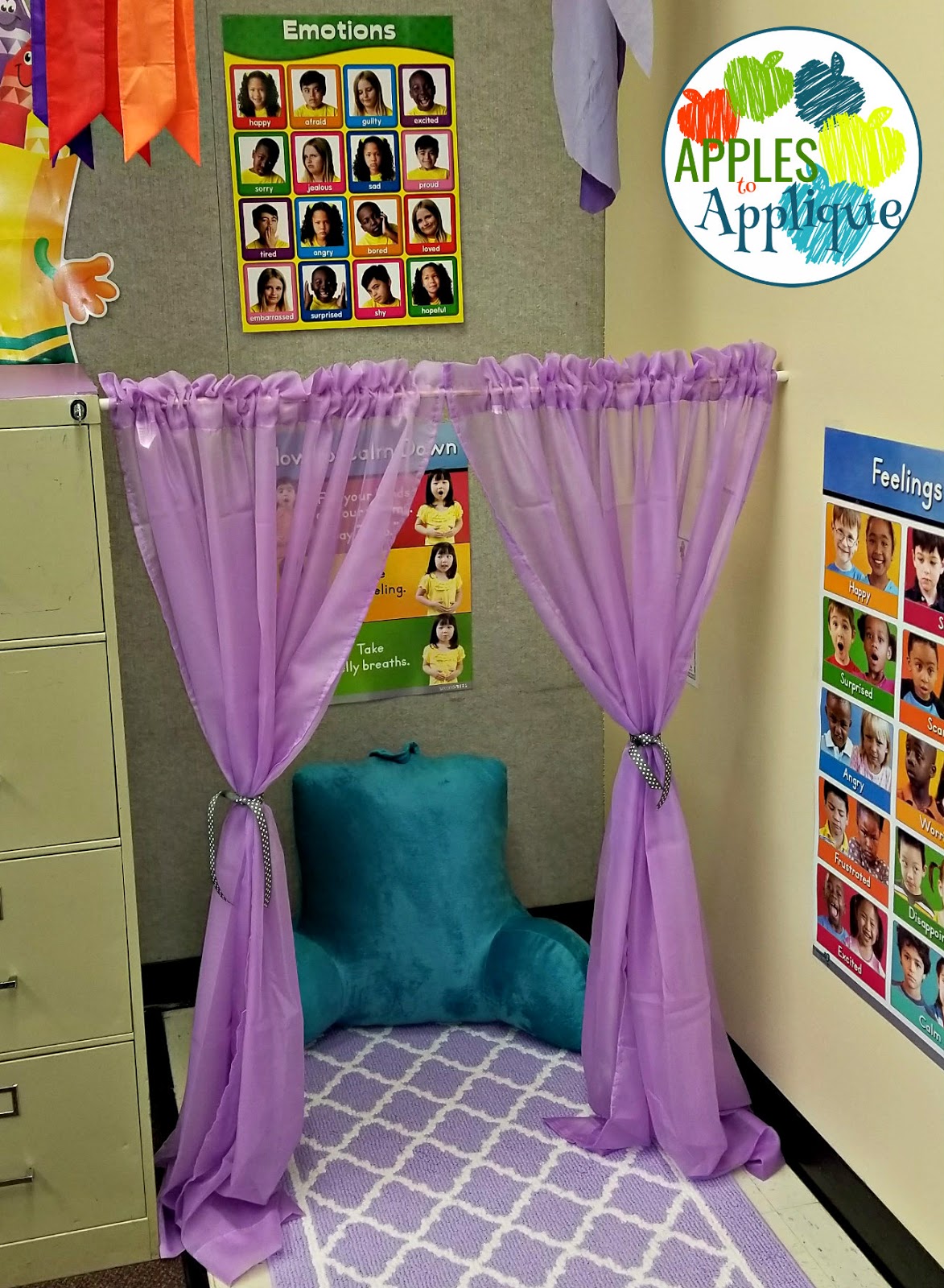
I made some big changes in my room this year. First, I set up a mindfulness corner.
This space is reserved only for kids who need some space to calm down and regroup. It is NOT a time-out area; kids can choose to go there if they feel sad or angry, or even if they feel too excited and wound up. At first, it was an area of great interest, and all of my kids would ask to go in there to read or play. They quickly came to understand, though, that's not what the space is for, and now they only use it if they need it. In the mindfulness corner are some calm down cards, with choices for students to help them relax. There are also posters to help them identify their feelings.
We have also been starting every day with meditation. One of my awesome paras spent a year teaching in Thailand, and told me how all students there meditate at the beginning of every day. I loved the idea, so now that's how we start our mornings. The kids are used to it now, and it gives us a positive start to our day. Just 4 minutes of sitting quietly, listening to calming music. We more than regain that 4 minutes the rest of the day, as the students are then ready to learn!
We have been practicing different breathing techniques, such as the Balloon and Drain from Conscious Discipline. One of my favorite things has been Daniel Goleman's suggestion to use Breathing Buddies. Breathing Buddies are stuffed animals that help students focus on their breathing. They lie on their backs with the stuffed animals on their tummies, and watch as their breaths make the animals go up and down.
All in all, we are off to a much calmer, smoother start this year. I think starting our day with meditation helps establish that the classroom is a calm place to be. Giving kids practice identifying emotions and the space to process those emotions, as well as strategies on how to respond, gives them a sense of control over their lives, and with it, some peace and a renewed focus for learning!
I don't just mean what my therapist husband calls "Little t trauma", I'm talking about "Big T Trauma". Stuff little kids should never have to worry about.
Kids don't know how to appropriately process and respond to that kind of stuff (and if we're honest, many of us as adults don't know how, either!), so they react. They lash out, they act up, they do anything they can to try to gain some kind of control over their little worlds, and to make sense of their lives.
Unfortunately, there is not a thing we as teachers can do to change situations in these kids' lives outside of school. We are completely powerless in that area. BUT, what we can do, is give them tools to process what they are going through. After the year I had last year, I spent all summer researching. How to calm irate children, how to stop outbursts and misbehavior. What I found is not at all surprising: there is no easy fix. The important thing is to give kids strategies, to teach them how to respond instead of react.
One word that kept coming up in my reading was mindfulness. Eagerly, I searched and searched for articles explaining how to teach mindfulness in early childhood, but I kept coming up empty. The problem is, mindfulness is something that must be learned, but it isn't something you can really teach. It's something that must be done intentionally and with practice. I realized that I must teach my kids strategies, help them learn to feel and identify their emotions, and give them time and space to process and respond to things happening around them.
I made some big changes in my room this year. First, I set up a mindfulness corner.
This space is reserved only for kids who need some space to calm down and regroup. It is NOT a time-out area; kids can choose to go there if they feel sad or angry, or even if they feel too excited and wound up. At first, it was an area of great interest, and all of my kids would ask to go in there to read or play. They quickly came to understand, though, that's not what the space is for, and now they only use it if they need it. In the mindfulness corner are some calm down cards, with choices for students to help them relax. There are also posters to help them identify their feelings.
We have also been starting every day with meditation. One of my awesome paras spent a year teaching in Thailand, and told me how all students there meditate at the beginning of every day. I loved the idea, so now that's how we start our mornings. The kids are used to it now, and it gives us a positive start to our day. Just 4 minutes of sitting quietly, listening to calming music. We more than regain that 4 minutes the rest of the day, as the students are then ready to learn!
We have been practicing different breathing techniques, such as the Balloon and Drain from Conscious Discipline. One of my favorite things has been Daniel Goleman's suggestion to use Breathing Buddies. Breathing Buddies are stuffed animals that help students focus on their breathing. They lie on their backs with the stuffed animals on their tummies, and watch as their breaths make the animals go up and down.
![]() |
| The kids love using Breathing Buddies! |
Subscribe to:
Posts (Atom)